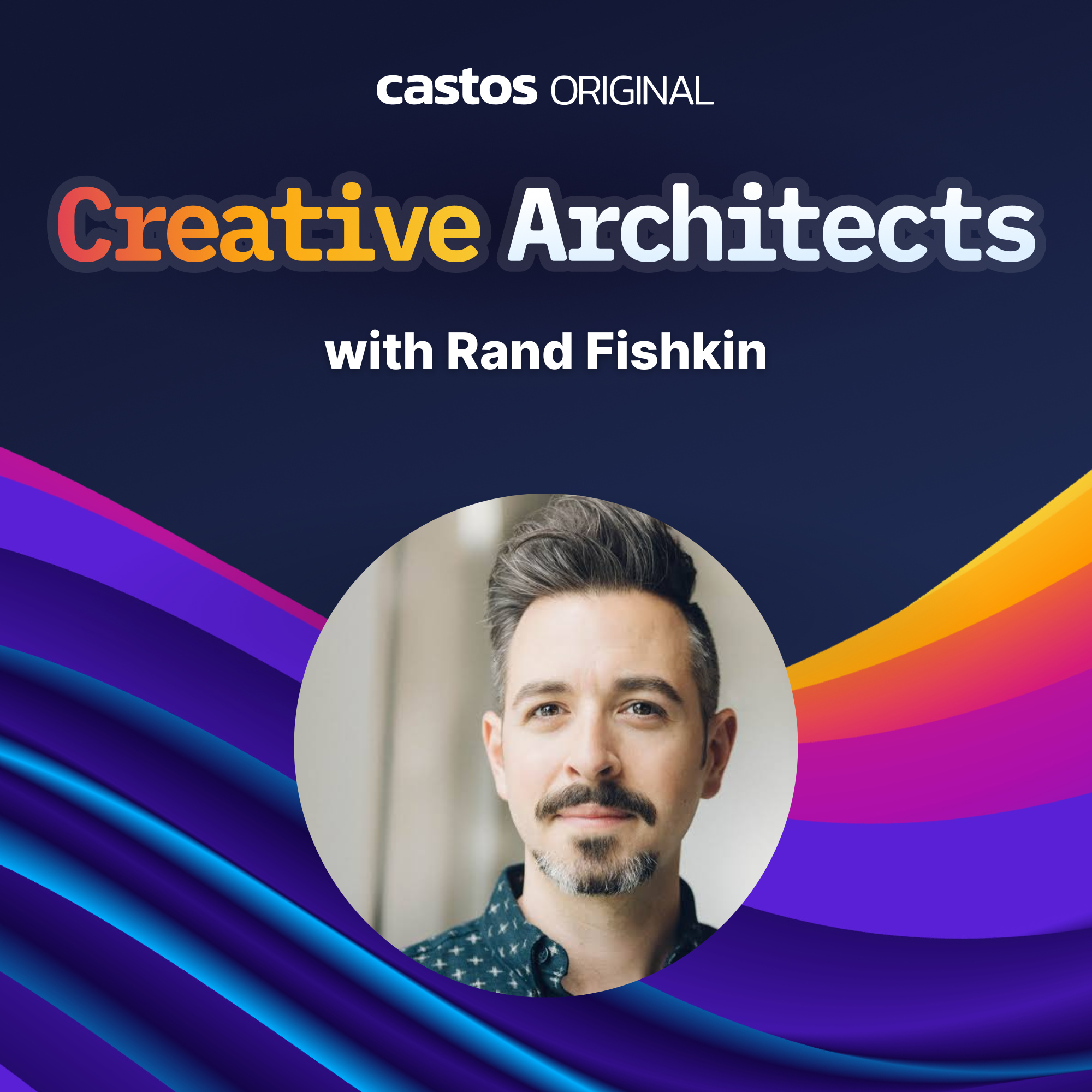
[00:00:00] Speaker A: Hey, everyone. Welcome to Creative Architects. My name is Angela Hollowell, and I am your host, and this podcast is about the future of the creator economy. Today, I am here with Rand Fishkin, who is one of the founders of Spark Turo. Yes, with a beautiful wave there. And today we'll be talking a little bit about data. And while numbers may not be sexy, we're going to do our best to try to make them so.
[00:00:31] Speaker B: We're going to listen to what other people say, what people we care about whose opinion matters, because they're potential customers. They're our audience. They're the people we want to serve. We're going to listen to them, and we're going to use the language they use.
[00:00:44] Speaker A: This podcast is brought to you by Castos. One of the best ways to learn something is to go directly to the top people in that field. At Castos, we do just that. Each episode of Creative Architects features creators who have taken their work to the next level. We hope that by watching and listening, it will inspire more creativity in your work along the way. Castos wants to be a part of your creative journey. From our suite of tools, feature, rich hosting platform, and even our production services, we're here to help connect directly with us by emailing
[email protected]. Or by clicking on the link in the description.
Thanks for tuning in. It means a lot. I hope you enjoy the show. So Sparkturo really solves a problem that we all know exists, which is the lack of searchable data about where our audience is hanging out online. And when we think about creators making or founders creating companies that solve a problem, this problem was clearly evident. Right? And there are very few other organizations or companies in this space who have done what you've done at the level that you've done it at. So talk to me a little bit about, one, how Sparkturo kind of flipped search engine optimization on its head and looked at where Target audiences were hanging out online.
[00:02:03] Speaker B: My previous company was Maz, which was in the SEO software space and obviously helped lots of people optimize their websites and improve their rankings in Google. And as I was leaving Maz, this is 2018, right? We were sort of transitioning from a world where everyone on the Internet went to Google as the first place to discover all of their information. I think that era kind of started to end in 2012, and nowadays, 1011 years later, it's essentially gone. I think Google is much more today a place where we go to navigate rather than to discover and find new whatever brands or new creators or new sources of influence. And that's both because as the Internet got more established, right, we're 25 years into the Internet instead of ten or 15. Everybody has their hangouts. Like, we have our haunts, we have our people that we follow, we have our brands that we trust. We have our news sources, we have our YouTube channels, we've got the people that we follow on Instagram and TikTok. Even though following someone on I was going to say following someone on TikTok doesn't really mean that you'll ever see their stuff, which is sort of interesting. It's not a follow behavior that has a whole lot of meaningfulness, but on almost every other platform, that behavior does. Right. You can think of it in the early Internet terms as like, I bookmarked all these sources and that's what I visit. And so what Casey and I, my co founder and I really wanted to do was try and help businesses, marketers organizations, creators, understand where is my audience? Who and what do they follow, listen, pay attention to, read, watch, discover. What are they talking about, and then who are they like, demographically? And so that's essentially what SparkToro, I would say, tries to do. We do a lot of that quite well today, but I would say we're not even a quarter of the way into the journey of what we think is possible in the long term. That's our starting point.
[00:04:04] Speaker A: Before we move on, I just want to say I love this Adventure Time trio situation that you have in the yeah, yeah.
[00:04:12] Speaker B: Angela, those paintings, I'm so glad you mentioned them. We just finally got them up because we moved houses and I got a new office, all that kind of stuff. But my wife Geraldine actually painted those for me for like, birthdays and Hanukkahs and special occasions over the years. And so now I think I have six of them that she painted. I just love it. I don't know if you're watching the new HBO Max, Fiona, and Cake, but that is great.
[00:04:38] Speaker A: I need to thank you for letting me know. Oh, my God. Okay. I know what I'm doing tonight. Okay.
[00:04:43] Speaker B: So anyways, it's outstanding, especially if you watched Adventure Time and loved it, which I did.
[00:04:50] Speaker A: Yes, absolutely. So, getting back on track sorry, we need to have a little creative sidebar.
[00:04:57] Speaker B: These are important sidebars.
[00:04:58] Speaker A: They are. They so are. You made a really interesting comment, which is something that I've seen echoed in some form of fashion in other spaces, which is that TikTok's followership isn't as meaningful as, like, a YouTube followership. And it always gets compared to YouTube because YouTube and TikTok are primarily video. Know, Instagram is its own space. It has video, but it has not always been a video platform, even though it's prioritizing that now. And there's other ways to engage on Instagram. And I think Instagram is a little more social than your TikTok or your YouTube, where, yeah, you may leave comments, but this isn't someone that you're having a conversation with strictly on that platform. If you're having a conversation with them, it's on Twitter, it's in a discord, it's on a know, it's on some kind of community based channel, not in the YouTube comments or the TikTok comments. And I find that very interesting because when we think about marketers agencies creating social video, which is all the rage right now and for a good purpose, I think social video serves an incredible purpose and is an incredible discovery tool. Right, but when you're saying, well, even though you may be posting videos on TikTok, it's not that great of an indication that people that are following you are necessarily people that are your target audience. They just may enjoy your videos, right. So talk to me a little bit about when people are thinking about using this data from Sparkturo in order to maybe guide or restructure their marketing efforts, what that means for them, what are some key things they should look for when discerning what data to use and how to apply it.
[00:06:29] Speaker B: I think there's two ways to think about this data challenge and the problem of audience research overall. And one is I want to go learn about my audience without any particular agenda in order to surface potential opportunities, right? So whatever it is, I'm going to look at this group of people and their behaviors and their demographics, and I'm going to see if something hits me like, oh gosh, a lot of interior designers pay attention to sources of influence in the hiking and outdoors world. I never would have thought of that. I don't really have an agenda that was going to be a partnership or a promotion or an event that tied that together. But now I'm thinking about it, maybe I will do something that sort of interior design meets exterior, sort of outdoors like activities and all right, we're going to do something like that for our next conference. So that's one way to think about it. And the second is I have a specific objective. I am trying to improve or optimize my Google Ads targeting. I want to know which websites I should put in as priorities in my Google Ads account or which YouTube channels I want to prioritize in there. Or I'm going to Facebook and I'm looking for a I want an audience like the audience that follows these sources. All of those things are potential parts of sort of an agenda based audience research. You can choose which one you want to do. I don't have a lot of judgment around either one. I think both are very appropriate ways to go. I'll say that for Sparktoros customers, agencies and consultants often do the first one, and in house marketers brands, creators often do the second one. They come with a specific agenda, which is great. I'll also say this about TikTok. I think you make a great point about both TikTok and YouTube. When you, as a user of those platforms, subscribe to a channel or subscribe to a creator on TikTok, those platforms don't push that content into your feed with the same efficacy and consistency that you see on Instagram, LinkedIn, Twitter, Reddit, facebook, virtually every other platform. The feed is comprised of things you've told it you want to follow. YouTube and TikTok kind of the inverse of that, right? They learn what they think you're going to like and engage with and that's what they show and push to, you know, for YouTube, it's like related videos and what's on your homepage and that kind of thing. For TikTok, obviously, it's just what you swipe to next.
[00:09:06] Speaker A: And I think you make a really good distinction between in house marketers and brands, right? And like, as soon as you said interior design and the outdoors, the first thing I thought about was Airbnb's campaign with like a was like and it was like that match. And I just immediately knew what you meant. I didn't know if you were making that up, but in my mind I was like, yeah, that actually makes sense because Airbnb had a really great campaign about Is. I'm trying to remember.
[00:09:36] Speaker B: I think Lego found last year or two years ago they did some audience research and they found that there was a big crossover between a certain segment of people who buy Legos and build them and people who play the tabletop game Dungeons and Dragons. And so they decided they were going to do a partnership with the people who make Dungeons and Dragons, which is based here in Seattle in my hometown called Wizards of the coast. And so now they're doing a campaign where people on various social media, I think it was particularly heavy on Instagram, they worked with people who are popular in that community to vote for what things do you want to have a Dragon Lego or do you want to have a Barbarian Lego or whatever it is, right? And that was fascinating, like amazing to see that audience research at that scale.
[00:10:27] Speaker A: No. And I love that. I love doing that and seeing that. And I think quite frankly, I know this is like a controversial statement right now, but WGA did just get a tentative contract, so I feel comfortable saying it personally, but I think we see some of this subtly in movies and in TV shows, kind of the intersection of this show. What brands do fans of this show like, or what fans of my brand do? What do they watch, what are they interested in? And so product placement, I think that's so subtle. But you remember it though. You remember it, you're like, oh yeah, they're driving a Chevy, or oh yeah, they're using all Microsoft tablets or all Apple tablets or whatever. So it's an interesting space. I think audience research can be used for a lot of different things and a lot of different exciting things. And to me, Data, like I said, I don't think it's sexy to most people, but I think it's a beautiful thing because you can kind of see, well, not only what is my audience like, but how many of the things that they like, do I also like and just not talk about.
[00:11:31] Speaker B: I think this is one of the things sometimes when I talk to creators, they have a sense that it would be inauthentic or pandering to create particular kinds of content that are just serving their audience's, whatever interests. And I completely get that. Right. I grew up in the era of Kurt Cobain and Eddie Vedder and Don't Sell Out, which was I think, like Grunge's big contribution. So I understand the desire to be artistic before you are commercial and I think that's actually a wonderful thing. I think you build authenticity, you build trust, you build relationships with your true fans who love your work. And also, I don't think it's the worst thing in the world to go and look at what else your audience likes, is interested in, is visiting, is reading, is watching, so that you can potentially use that information to grow your audience or deliver better content for them, or do partnerships with people that you like and also have an overlap with the audience you want to reach. I think this is especially valuable, though, if you are a brand thinking about working with creators and influencers and sources of influence, press, media, all that kind of stuff. I would say what doesn't make any sense to me and what I see all too often is, for example, someone like, here's a great example, angela, my wife Geraldine is an author. Her first book came up out a few years ago. She just finished her second one, penguin Random House has got their publicity team and they're going to start working on the promotion of the book in a few months. And we were talking to some PR folks who we could privately hire and contract and there was a lot of bias toward big media outlets, right? Like, oh, well, we know that authors want to get on Good Morning America and the Today show and this NPR Book Review and get to the New York Times bestseller list. And I'm not against any of those things. I don't think any of those are bad. But one of the arguments that I made to the PR folks was I think there's a huge difference between sources of influence that have big wide reach and sources of influence that will reach the audience that's already familiar with Geraldine's work and are most likely to click that Buy button. I would like to see some prioritization, maybe even more prioritization on hey, this podcast only gets whatever, 5000 downloads per episode, but they're from people who are exactly in the right audience and yeah, sure, Good Morning America might be watched by, I don't know, half a million people nationwide still. What percent of them are actually going to go to Amazon or Powell's or Indiebound or whatever and click the Buy button? I think that number is low. And so I want to aim for high relevance, small niche source of influencer creator over big media thing that I've heard of. Like, one is great for making your grandparents parents proud of you, and one is great for selling your thing.
[00:14:37] Speaker A: I feel like you just made the case for influencer marketing, which is a great transition.
[00:14:44] Speaker B: I worry that when we say influencer marketing, people think we mean, like, dude with six pack ABS who's like, on the beach and poses with your product and you pay him $500.
I want to change that idea to or broaden that idea to all sources of influence. Someone has a podcast that's a source of influence. Someone runs a niche website. Someone is very popular.
[00:15:11] Speaker A: I don't know.
[00:15:11] Speaker B: They have a popular discord channel. They've got a YouTube channel. They have a monthly webinar series. It could be anything. B to B or B to C. And those sources of influence that really reach your audience, that's where the money is, I think.
[00:15:24] Speaker A: I think so. And I agree with that. I think as we talk about data and the intersection of creativity, the latest platform that I'm aware of to start allowing creators to monetize their audience is Twitter. If you still call it Twitter, I still call it.
[00:15:41] Speaker B: Eventually. Eventually he's going to get tired of all this BS and sell it, and then somebody's going to be like, okay, we're not keeping your stupid name. We're going back to Twitter. Right?
[00:15:50] Speaker A: All I can say is when I put in Twitter.com in my computer, it takes me to the same website it's always taking me to. So that's all I'm going to say.
But one of the more controversial things that he did prior to allowing creators to monetize directly from ads and things like that on the platform, and not just like subscriptions, was showing people's reach per tweet. And a lot of people didn't like that. They were like that's private. That's for me only. I don't need the whole world seeing how many people or how many impressions this tweet got. Now it's months later, and people are, I guess they're just used to know at this point. But as we think about those numbers, which are now public, right? So it's even harder for Twitter users, Twitter creators to kind of fudge the data in order to get a brand deal or a sponsorship, which is whatever. I don't know if that was even a thing. So I don't think it really matters that much.
[00:16:39] Speaker B: I mean, Twitter engagement is down so far, right? Traffic engagement, real users. Even Elon himself has been like, god, the bots are still coming. I might have to charge everyone in order to prevent bots. I don't see that network know, whatever has made him effective at running hardware companies does not translate to a social network.
[00:17:01] Speaker A: Yeah, and I think part of it too, is people are starting to realize that one thing they loved about Twitter, for all the chaoticness that it is beautiful, chaos, as I call it, twitter listened when they tried to make it so that you by default, quote, retweeted something every time you hit that button. And people are like, absolutely not. We hate this. They changed it within 24 hours, and now we're losing that. And I think the other side of data is social listening, right? So seeing what people are saying and thinking and searching and key phrases they're using to describe themselves, right, versus what you may want to call them. And I think that's such an important part of data as well, because I think it gives us a realistic picture and not just the idealistic picture that we want to see.
[00:17:47] Speaker B: I mean, this is something I think every especially in B to B, but even B to C as well. The ability to use the words and phrases that your customers, your best customers use to describe your product, the problem that you solve themselves as a group, it's powerful, right. I think there's a distinct authenticity to it, right. Instead of like a bunch of brand marketers sitting in a room and deciding, hey, we're going to call it this and we're going to call our customers this, this is how we're deciding. Instead. We're going to listen to what other people say, what people we care about whose opinion matters because they're potential customers. They're our audience. They're the people we want to serve. We're going to listen to them and we're going to use the language they use. That is not pandering. That is empathy. That's recognizing how someone else feels, how they talk about you and then mirroring that back in a way that says we're taking cues from you instead of telling you how you have to talk about, yeah, yeah, for sure. I thought Barbie did a really good job with that. I know that's a weird one, the movie, right?
[00:18:54] Speaker A: Barbie was everywhere. First of all, I loved Barbenheimer. I loved just everything that they did, okay? I feel like if there's like a ten out of ten, no notes film, like preshow marketing campaign, no, I'm not even a Barbie fan, and I went to see this movie, okay.
And I think that's the power of allowing your collaborations to speak for you and reach a new audience in the way that they talk. It wasn't like I watched it because somebody forced the idea of loving Barbie and pink down my throat or Mattel or anything like that. Who even knew that Barbie was made by Mattel before this movie? Probably like two people.
[00:19:37] Speaker B: It could have been hasbro for all.
[00:19:39] Speaker A: So it's just know, how are we allowing people to come into consciousness of us, right, and how can we even with that variation of understanding of who we are and what we do or what we're trying to portray, how do we still keep some consistent thread throughout that and maintain our sense of self? Because the Barbie movie didn't change based on people's feedback to the marketing campaigns. Right. So multi levels of consciousness and data. But I loved it. I thought it was a great day for me. Anytime that Issa Reyes, President, is great with me as.
[00:20:16] Speaker B: That. I think this is one of those things where the creators both had their own artistic vision and they also listened to the audience and involved a lot of not even popular culture, but a lot of niche cultural memes. Ideas and in a way that somehow was authentic in a movie that is basically using one of the most problematic childhood products that's come out right in the last hundred years.
Barbie really, I think, set the cause of feminism back dramatically. And here it is turning itself on its head and being a potential force for at least some good ideation. Yeah, that was quite impressive to see. So, again, I mean, going back to what we were talking about, right? If you can I don't want anyone to compromise their artistic vision. If you're a creator and you have something beautiful you want to put out in the world and you are unwilling to sort of change and make it more accessible for your audience or something that your audience wants, that's fine.
A lot of groundbreaking artists happen that way. I don't want to stop you from doing it. But also, if you are a creator, if you're an artist, and you would like to get your work in front of more people, or you want it to resonate more, or you want to use the language that your audience is using, you want to describe people the way they describe themselves, then audience research is great. Right. And Sparktor is not the only way to do this. Absolutely not. I would actually start with surveys and interviews. I think that's the best place to get your data, right? If you have an email list, put together a small survey, ask the questions that are important to you to better understand your audience, see if you can get a few hundred of them to fill it out. That's fantastic, right? Phenomenal. Way to go. You can share it on your social channels, too, and get some survey responses. I've done that a few times and then I would do some interviews, right? I'd reach out to like, 1020 people, be like, hey, can we just chat? And I want to learn more about how you're engaging with this and what you like and what you don't like and why and what are the problems you're having, what are you struggling with? You're going to get some great ideas. You're going to meet some awesome people. I promise you'll come away from that experience better off for it. And then you can get some sort of big data at scale through something like a SparkToro or something really simple like a similar web, right? You can plug in a website and see the other websites that are visited for free. SimilarWeb has that great free version, right, that'll show you like people who do X also do Y. Great, fantastic. Use that data.
[00:22:46] Speaker A: What's interesting. So for me, in terms of asking my audience questions, one, early on, I wouldn't ask my audience questions. And it's not because I didn't have questions. It was because I was afraid that nobody would respond or the people that would respond wouldn't be honest with me because they were likely like people that I knew.
[00:23:06] Speaker B: Totally.
[00:23:06] Speaker A: Right.
Obviously, yes. Do your own surveys still reach out to your audience? But I do think there's definitely some conversations around how to ask certain questions maybe, and also how to ask informed questions so that you can get a response that is useful to you and your business or your marketing campaign or whatever it is you're creating. And I would love to hear from you how brands have maybe had to reframe their thinking about, well, how do we use this information? Because this isn't the end all, be all. Even though it's a starting place, I feel like Sparktora is a really great starting place for understanding where your audience hangs out. And then if you want to do deeper audience level research, it's using that data to form the right questions, right? Instead of just saying, do you like Barbie? It's like, do you?
[00:23:58] Speaker B: This is the challenge. Right. So I think those surveys and interviews are great for asking almost what I call broader questions and more of a person understanding, right. Empathy, relationship building. You can get some demographic data, which is fine too, and some behavioral data, but it's really hard to ask a question like, what podcasts do you listen, know it doesn't work. What you really want is like, okay, let me steal your phone and look at your Amazon account and your Audible account and your web browsing history, right, and your Apple podcast history.
That's ideal, that's obviously criminal, and no one's going to share that with you. But the good news is that a lot of that data is public.
You won't be able to associate the account to a human being. But if you go to Apple podcasts, you can see like, oh, here's millions of people and here's all the podcasts they're subscribed to. If you go to YouTube, you can know if you visit my YouTube page, you'll see every channel I'm subscribed to, every comment I've left, every video I've posted. So you get this pretty rich description of a human being and then you can go and look at Know Anonymously in something like Spark Toro. And so, you know, we're looking up interior designers and I see that a lot of them also have an interest in architecture or an interest in a lot of them also use the word architecture in their bio or profile. A whole bunch of them say consultant or independent. And you're like, oh, I guess a lot of interior designers sort of work for themselves. Like they're small business owners. In addition to being interior designers, they're not working inside a firm. That's an interesting insight. That probably means that if I am trying to reach them, target them, I need to think about them as small business owners, not just as doing this career as a traditional type of job inside an organization. That sort of data can be very, very valuable for targeting, for messaging, for creation. And I think I just tell people like, hey, go browse and look at it and then see if you can think about the applications that would make sense for you.
[00:26:05] Speaker A: So, last question here. I would love to hear what Sparktor has on the horizon. I know it's been a while since you shipped a new feature, and there may be a little something up your sleeve coming here.
[00:26:17] Speaker B: Got it. Let's see what's in.
So, you know, Angela, we were actually very reliant on Twitter as sort of a connector network. So Twitter pre elon had an API where we could see people who follow X also follow Y. We use that API for a long time. As well as getting the 350 ish million profiles that are on Twitter, which are the ones that are public, we'd crawl their profiles and then associate them with all their other profiles on the web. Obviously, once the Twitter takeover happened, we were pretty nervous that that was going to be going away. And in was that February? I think they sort of dropped the hammer on a lot of that stuff. So for the last six months, seven months now, we have been rebuilding SparkToro's infrastructure to instead use a combination of three data sources. One is Google Search Data, so what people search for, and then the websites that they click on, and that rank well. The second one is Clickstream Data, which is sort of like people who visit this site also visit these websites. People who visit this profile also visit these other pages and sites on the Internet. And then the third one is LinkedIn, which is going to be kind of our big connector network. A lot of the Twitter activity has moved to LinkedIn, especially in professional spaces, and so that's going to be our connector network for the future. LinkedIn also has a nice system whereby most people who have a professional LinkedIn profile also have a link to their other presences on the web, either their own website or their link tree or their Instagram or whatever. And so we can build those connections. So that new product, a whole ton of new features is coming out, hopefully in about 60 days, maybe even less.
[00:28:03] Speaker A: Okay.
[00:28:03] Speaker B: I'm actually working on some of the categorization in one of my browser tabs as we're speaking.
I got to finish up for my co founder.
[00:28:11] Speaker A: Nice. Well, thank you so much for coming on the show and sharing a little bit about Sparktor's approach. To audience research and helping brands and individual Joel's creators alike find out a little bit more about where their target audience hangs out.
[00:28:24] Speaker B: It was my pleasure. Thank you for having me. Angela.
[00:28:28] Speaker A: That's all for this episode. If you enjoyed it, please give us a five star review on your listening app. Like this video? If you're tuning in on YouTube and subscribe for more episodes, I'll catch you in the next episode.